The Origin Story of Urbilateria
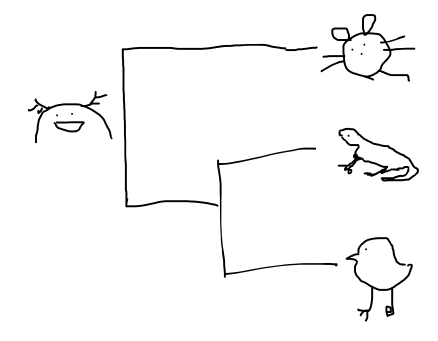
It began with an unnamed common ancestor, sketched in the corner of a phylogenetic tree by a postdoc.
“Is this the common ancestor of amniotes?”
“Isn’t it an axolotl?”
“What are those horns?”
“Are those external gills?”
“More importantly, isn’t its mouth huge?”
The small doodle sparked an unexpectedly large debate.
As the discussion continued, someone said:
“If it is neither an amniote ancestor nor an axolotl, perhaps it is something much older—the common ancestor of all bilaterians?”
And so, the unidentified common ancestor somehow came to be known as Urbilateria.
Are they horns, external gills, or merely unruly hair? We still do not know.
One leading theory holds that the large mouth is for talking with researchers from many different fields.
Most of this is made up.